We are pleased to announce that Prof. Anthony Lau, an active member of CERC, has been awarded a 3-year research grant under the NSERC Alliance program for his work on sustainable waste management and renewable energy. This project, in collaboration with Providence Health Care (PHC), aims to develop innovative solutions for converting food waste from healthcare facilities into renewable natural gas (RNG) and other valuable resources.
By leveraging anaerobic digestion (AD) and advanced biogas upgrading techniques, Prof. Lau’s research will explore cost-effective and eco-friendly methods to reduce greenhouse gas emissions while producing clean energy. The study also integrates life cycle and technoeconomic assessments, ensuring practical applications for healthcare facilities across British Columbia and Canada.
UBC is pleased to announce the recipients of the 2024 Faculty Research Awards. UBC’s Faculty Research Awards recognize the research excellence and scholarly achievements of faculty from across all disciplines, ranging from the applied sciences and medicine to the social sciences and humanities. Award recipients are selected by UBC’s Faculty Research Awards Committee and include early career researchers through to established members of faculty.
The Office of the VP, Research and Innovation will be hosting a reception on June 5, 2025 to acknowledge the achievements of our researchers.
Two CERC members were selected as award recipients. Congratulations!
Seismic rehabilitation of steel, concrete, masonry
Seismic analysis and building design
Current Research Work
Smart Materials and their Structural Applications
Seismic Rehabilitation of Steel, Concrete and Masonry Structures
Progressive Collapse Analysis of Structures
Performance-based Design of Structures
Recycle/Reuse of Industrial Wastes for Structural Applications
Dr. Alam’s current research projects include the design of frame structures against progressive collapse due to blast loading, seismic design guideline for shape memory alloy reinforced concrete frame structures, rack clad buildings, braced concrete frames, base isolated structures, seismic performance assessment of highway bridges in BC, seismic retrofitting of highway bridges, and green concrete from industrial wastes.
Professor sue.baldwin@ubc.ca Home department: Chemical and Biological Engineering
Research Interests
Bioprocess Engineering
Anaerobic Fermentation
Bioremediation
Reactor Modeling
Biochemical Reaction Modeling
Reaction Kinetics
Current Research Work
Biomonitoring: Using metagenomics to monitor bioprocesses for process optimization and control, and impacted environments for microbial response, resilience and recovery to disturbances.
Bioprocessing: Developing nature-based technologies following the principles of zero waste and a circular economy within the natural resource sectors of mining, forestry and agri-food industries.
Biomining: Recover nutrients and strategic metals, such as selenium, zinc and copper, from mine wastes using microbially mediated approaches.
Forwarding invitation from the organizing host at National University of Singapore
We are glad to announce that the 3rd World Conference on Engineering Thermochemistry (WCETC 2025) will be held on 26-29 July, 2025 in National University of Singapore. On behalf of the WCETC 2025 Organizing Committee, we sincerely invite you to join us in the beautiful Garden City of Singapore and present your latest work in the field of Engineering Thermochemistry. We are now open for the Abstract Submissions on https://wsetc.org In addition, the 4th Annual General Meeting of the World Society of Engineering Thermochemistry (WSETC) will take place at the same time. WSETC, registered in August 2022, is a registered not-for-profit organization and network for engineering thermochemistry researchers and professionals. It has the breadth of resources and expertise you need whether you are in the core thermochemistry industries or emerging areas. The conference attendees will be from all over the world, with an excellent opportunity to strengthen our network and jointly advance the development of Engineering Thermochemistry.
For detailed information, please refer this event brochure.
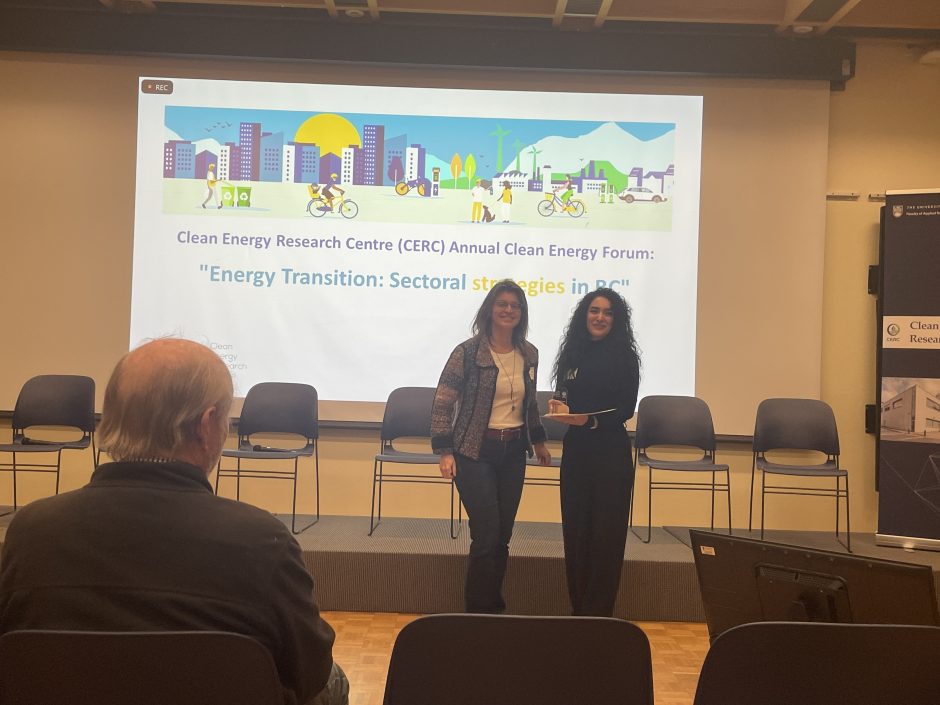
Following last year’s Clean Energy Forum on the BC “energy transition” to meet the 2030 climate target (i.e. 40% below 2007 emission level), this year’s Clean Energy Forum focused on sectoral “Energy Transition” to meet the CleanBC targets for specific sectors (i.e. Buildings: 59-64%; Transportation: 27-32%, Oil and gas: 33-38%, and other industries: 38-43%).
Keynote presentations from industrial experts highlighted the decarbonization strategies and plans in six important sectors (Building, Electricity, Mining, Oil & Gas, Pulp & Paper and Transportation).
Over 100 students, faculty members, and industry partners participated in this year’s event.
Oil Sector: David Schick, VP Western Canada, Innovation and Regulatory Affairs, Canadian Fuels Association
Gas Sector: Tyler Bryant, Director of Decarbonization and Sustainability, FortisBC
Transportation Sector: Ralf Nielsen, Director of Enterprise Sustainability, TransLink
Buildings Sector: Betsy Agar, Director, Buildings, Pembina Institute
Electricity Sector: Kristin Hanlon, Business Planning and Energy Management, BC Hydro
Pulp & Paper Sector: Davis Chiu, Partner, Global Investment and Innovation Incentives, Deloitte
Panelists
Together with the keynote speakers, four additional panelists discussed broadly the government policy and community engagement to support the sectoral energy transitions.
Arthur Bledsoe, Senior Policy Analyst, Renewables in Remote Communities, Pembina Institute
Gordon Floe, Suzuki Elders, Principal of NLK Consulting
Sean LeRoy, Executive Director, Low Carbon Fuels Branch B.C Ministry
Allison Macfarlane, Professor and Director School of Public Policy and Global Affairs Faculty of Arts, UBC
Winners of Oral Presentation and Poster Competitions
21 graduate students and post-doctoral researchers presented their posters. Four student researchers from UBC Okanagan campus participated in the poster competition via Zoom. 14 among them also participated in the 3-minutes oral presentation competitions. The winners of each competitions are selected by voting based on the preferences of the faculty members and industry partners.
Winners of Oral Presentation Competition
First place: Sawyer d’Entremont. Title: Pathway of Carbon Fiber Growth during Molten Metal Methane Pyrolysis
Second place: Keegan Parkhurst. Title: Feasibility and Scaling of a Capillary-Driven Artificial Tree
Third place: Natascha Miederhoff. Title: Production and Purification of Carbon Fibers using a Molten Cu-In Alloy
Winners of Poster Presentation Competition
First place: Shiva Zargar. Title: BIO-OPT: An Integrated Analytical Platform for Pioneering Sustainable Bioeconomy Solutions
Second place: Pu Yang. Title: Phase Diagram-Guided Molten Salt Engineering of Biocarbon Pores at Low Temperatures for Energy Storage and CO2 Capture
Third place: Peijin Jiang. Title: Mapping Material Recovery from Rooftop Solar Panels Using Computer Vision and Material Flow Analysis
Group photo of the winners. From left to right: Natascha Miederhoff, Peijin Jiang, Shiva Zargar, Sawyer d’Entremont, Pu Yang, Keegan Parkhurst
Assistant Professor eric.lees@ubc.ca Home department: Chemical and Biological Engineering
Research Interests
Electrochemical Engineering
Electrochemical Synthesis
Continuum Modelling
Reactor Design
Transport Phenomena
Electrochemical Separations
CO2 Capture and Conversion
Research Projects
Continuum and techno-economic/life cycle assessment modelling: Our group develops multi-scale, physics-based models that correlate the chemical and physical properties of materials to the performance of clean energy technologies. These models are coupled with techno-economic and life-cycle assessments to bridge performance outcomes at the laboratory- and field pilot-scales.
Electrochemical reactions and separations: Our group is interested in developing electrochemical separation processes for climate-related applications including CO2 capture, rare-earth metal extraction, and environmental pollutant remediation. The lab fabricates, tests, and characterizes materials (e.g., electrodes and ion-exchange membranes) to inform model development and design efficient electrochemical separation processes.
Atmospheric water harvesting: We are interested in developing multi-physics models for atmospheric water harvesting devices to address water insecurity in arid, landlocked regions of the planet. The goal is to develop rigorous models that couple adsorption, heat and mass transfer phenomena to co-design materials and devices that enable inexpensive atmospheric water harvesting.
The UBC Sustainability Hub is offering UBC graduate students the opportunity to work on funded sustainability internship projects.
They are currently accepting applications for 46 internships that will commence May 1, 2025. Current UBC graduate students from all academic disciplines are encouraged to confirm the eligibility requirements and apply.
Successful candidates work under the guidance of a mentor at one of our partner organizations, and are immersed in real world learning where they can apply their research skills and contribute to advancing sustainability and climate action across the region. Each Scholar receives $31.25 per hour to complete 250 hours of work.
Two CERC associate directors: Dr. Naoko Ellis and Dr. Kasun Hewage, together with UBC alumnus, Diego Mandelbaum, are invited as speakers to a webinar entitled “Harnessing clean energy to power an innovative future” on Wednesday, February 26, 2025, 12:00pm–1:15pm PT to discuss how their work — and the shift towards decarbonization — affects us and what we can expect in the future.
Taken from Alumni UBC webpage: In our first session in this series, we examined barriers to our clean energy transition. Now we’re spotlighting progressive projects that demonstrate how to overcome these challenges. From equity-based energy programs to low-carbon community energy systems, we’ll showcase initiatives driving positive change in our communities. A panel of UBC researchers and alumni experts will discuss how their work — and the shift towards decarbonization — affects us and what we can expect in the future. Why do these projects matter? Find out by attending this session to learn how close we are to reaching net-zero emissions!
This webinar is the second part of a two-part series — the first webinar,Finding our way to a clean economy, was on December 5, 2024 and the replay can be found here.
Application of Renewable Energy in Resource Sector
Energy Systems
Decarbonization
Research Projects
Application of microwave-assisted fragmentation in excavation and comminution of hard rocks/ores: the relatively low energy efficiency of rock fragmentation, including excavation/comminution, is among the most challenging mining industry hurdles. The microwave pre-treatment technique has yielded promising results compared to other pre-weakening solutions such as high-temperature rock cutting, electro-pulse defragmentation and hydrofracking. So far, the importance of the energy used in creating microwave-induced fractures is mostly overlooked. The primary goal of our research is to connect energy consumption and strength reduction by using numerical methods. Towards this end, A COMSOL-based numerical tool has been developed to simulate the microwave-treatment process taking place within the cavity. In addition to this Finite Element Method (FEM) tool, a Discrete Element Modelling (DEM) tool has been developed to evaluate the behavior of rocks undergoing microwave treatment. These numerical tools will be used to better understand rock fragmentation and macro-scale responses to achieve energy viability in microwave-assisted rock fragmentation processes.
Mine hybrid renewable energy system for application in remote mines: Due to its high fossil fuel dependency, the mining sector is one of the primary contributors of carbon emissions from Canadian industry (82.6 megatons in 2017 according to Natural Resources Canada). Consequently, miners are seeking more innovative solutions for fully transitioning their energy supply off fossil fuels especially in remote mines where lack of access to electric grid and natural gas makes them solely rely on fossil fuels for provision of power, haulage and heat. Renewable energy systems such as wind and solar photovoltaic can relieve this over-reliance on fossil fuels. Although some progresses have been made to shift towards green energies, high cost of battery storage system makes the current mine renewable solutions economically non-competitive with the conventional diesel-based systems. Using hydrogen and thermal storage systems due their relatively cheaper technologies can facilitate the application of renewable energies in mining industry. In this project we aim to develop a novel integrated renewable-multi storage (Battery/Hydrogen/Thermal Storage) solution for provision of fully-decarbonized energy in off-grid mining operations.
Design of integrated solar-borehole thermal storage systems: Solar thermal collector system absorbs the solar thermal energy year-round which is mostly stored during the summer days in underground through borehole heat exchangers. The stored energy is extracted during the winter months to supply the building heat demand. This research underlines the seasonal intermittency issues with renewable heating systems which can be effectively dealt by use of borehole thermal energy storage systems. A numerical simulation code is developed to couple the solar thermal collector system with the borehole thermal energy storage system. This code aims to study and explore the heat transfer mechanisms involved in the integrated system to gain a better understanding and enhance the performance of the system.