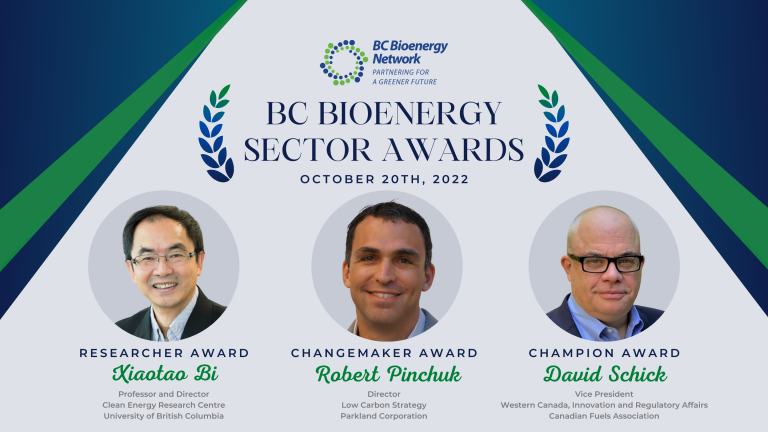
On Thursday, October 20th, 2022, BC Bioenergy Network announced recipients of the 2022 BC Bioenergy Sector Award during the virtual ceremony. This was the second annual celebration of the BC Bioenergy Sector Awards, the awards were presented for outstanding leadership and contribution to the bioeconomy sector in British Columbia.
Congratulations to the winners of the second annual BC Bioenergy Sector Awards 2022:
Maybe clean-energy research and researchers needs to engage differently to face the climate-and-ecological crisis?
September 27, 2022 @ 3:30 PM
Abstract
In many academic fields, science engagement is becoming a greater priority in the form of science communication and engaging with policymakers and practitioners. Energy research in particular has an obvious role in light of the centrality of energy transitions to addressing the climate crisis. Calls for system change seem to be the domain of activists, not academics. In this research-rooted talk, I consider the possibility that the climate-and-ecological crisis demands a re-think of all this. In particular, I argue that calls for system change have a clear basis in rigorous interdisciplinary research. I will discuss what this might mean for both science and engagement, and propose that perhaps we need a widespread focus on social-ecological transformation extending beyond energy systems, and a new set of pathways and approaches to engage with decision-makers and the public using science.designed and executed for maximum impact.
Biography
Dr. Kai Chan is a professor and Canada Research Chair at the Institute for Resources, Environment and Sustainability at the University of British Columbia. Kai is an interdisciplinary, problem-oriented sustainability scientist, trained in ecology, policy, and ethics from Princeton and Stanford Universities. He strives to understand how social-ecological systems can be transformed to be both better and wilder. Kai leads CHANS lab (Connecting Human and Natural Systems), and is co-founder of CoSphere (a Community of Small-Planet Heroes). Dr. Chan has published more than 150 articles and chapters including in Nature, Science, and PNAS, with an h-index of 53 and an i-index of 108 (over 23,500 citations total). In addition, he has over 60 other academic publications and over 135 op-eds, columns, and other outreach publications. Dr. Chan has garnered over $14M in research funding, including more than $2.5M as principal investigator. He is a member of Canada’s Clean16 and Clean50 for 2020; a UBC Killam Research Fellow; a Leopold Leadership Program fellow; senior fellow of the Global Young Academy and of the Environmental Leadership Program; a member of the Royal Society of Canada’s College of New Scholars, Artists and Scientists; Lead Editor of the new British Ecological Society journal People and Nature. He was a coordinating lead author for the IPBES Global Assessment; a director on the board of the North American section of the Society for Conservation Biology; and (in 2012) the Fulbright Canada Visiting Research Chair at the University of California, Santa Barbara.
Over the past year, CERC members have collectively made significant progress in research, development and outreach activities even under the impact of Covid-19 pandemic. Read more about some highlights from the past year.
Do you have a high-impact climate solutions research project? PICS’ OPP may be for you You can apply beginning April 28, 2022 to get your high-impact climate solutions proposal funded by the PICS Opportunity Projects Program (OPP).
OPP supports new and emerging leaders to pursue bold and impactful climate solutions research. PICS is open to your ideas and innovation, and we encourage teams to contact PICS staff to discuss their proposal before applying.
Successful projects are awarded up to $180,000 over a maximum three-year duration, and three to five awards are made per call. This year, PICS is offering an extra opportunity for a Zero Emission Vehicle (ZEV) Project, funded by the BC Government.
Applications for 2022 call for proposals close on Aug. 3, 2022. Notification of adjudication decisions will be made in December 2022, with projects to start in early 2023.
Mitacs Elevate provides critical career and skills training to postdoctoral fellows through real-world collaborations.
This call, we have increased postdoctoral funding from $60,000 per year to $80,000 per year for two-year research projects in key priority sectors. We are accepting proposals in seven thematic areas, including four from last year.
The complete list of priority sectors can be found below: Agriculture and foodArtificial intelligenceBiomanufacturingClean technologyEntertainment and mediaQuantum scienceSocial Innovation
Projects addressing at least one of the key priority sectors above can apply for an enhanced research award valued at $80,000 per year.
As an Elevate fellow, you will: Manage a long-term collaborative research project with a company or not-for-profit organization Receive exclusive professional development training in career fundamentals, interpersonal skills, communication, intrapreneuralism, leadership and management, and much more Cultivate cross-disciplinary networks and take advantage of peer-learning opportunities
Key dates: The deadline to apply is July 6, 2022 If you have questions or would like to learn more the application process, please consult our website.
John Tiedje was a graduate of the Department of Chemical Engineering at UBC who went on to a successful career with Imperial Oil, where he was responsible for developing several new processes for converting petroleum into value-added products. He served as manager of Esso Frances research lab in Mont-Saint-Aignan, France; as manager of the Esso Petroleum Canada Research Department in Sarnia, Ontario, until his retirement in 1983; and as chair of the Canadian Committee for the World Petroleum Congress.
Fellowships is awarded to students whose research will help create and maintain a healthy environment, with preference for research developing clean and renewable energy, advancing the electrification of the economy, reducing greenhouse gas emissions, or improving the efficiency of energy utilization.
Degree Level
MASc/PhD students (including incoming students) in APSC
Citizenship
Canadian citizen or permanent resident
Eligibility
Research ability and potential Experience and achievements relevant to clean energy and greenhouse mitigation, obtained within and beyond academia Demonstrate leadership quality in general area clean energy and greenhouse mitigation
Nomination Package:
1. Nomination letter
2. CV of the student
3. Transcripts of most recent two years of full-time study
4. Two support letters
Please include all the required documents for nomination in one single pdf and email it to sarah@cerc.ubc.ca .
 Joint seminar with China-Canada bioenergy Centre